


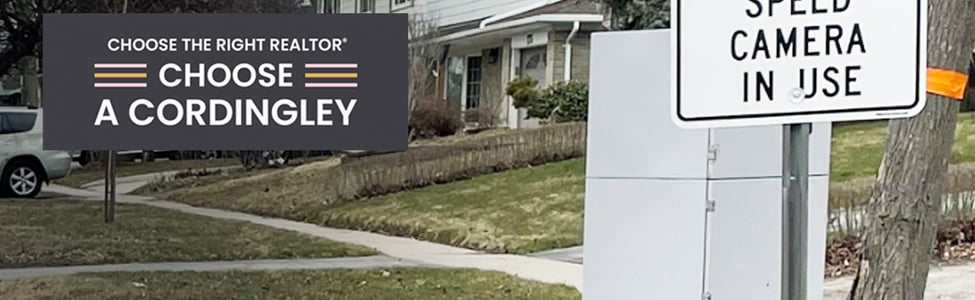
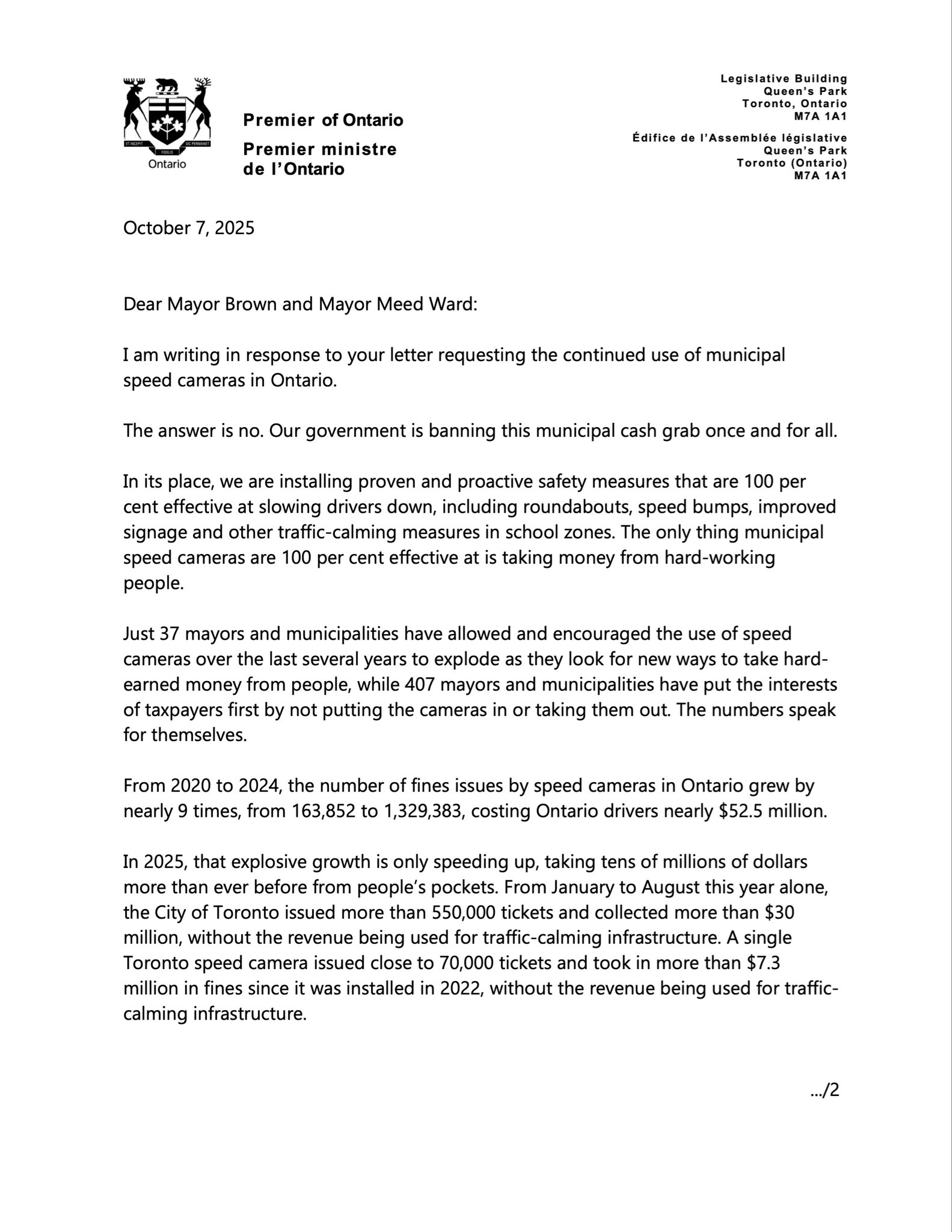
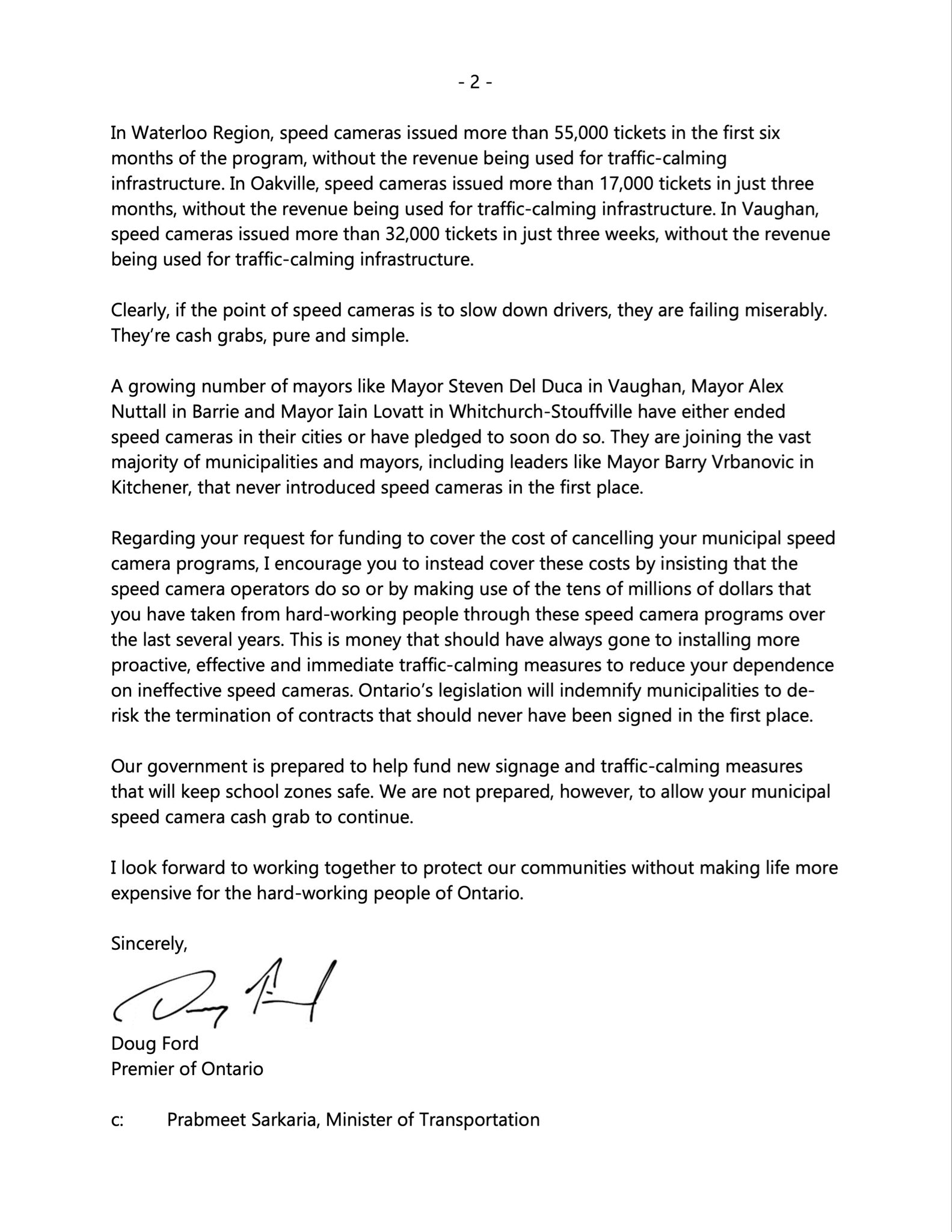
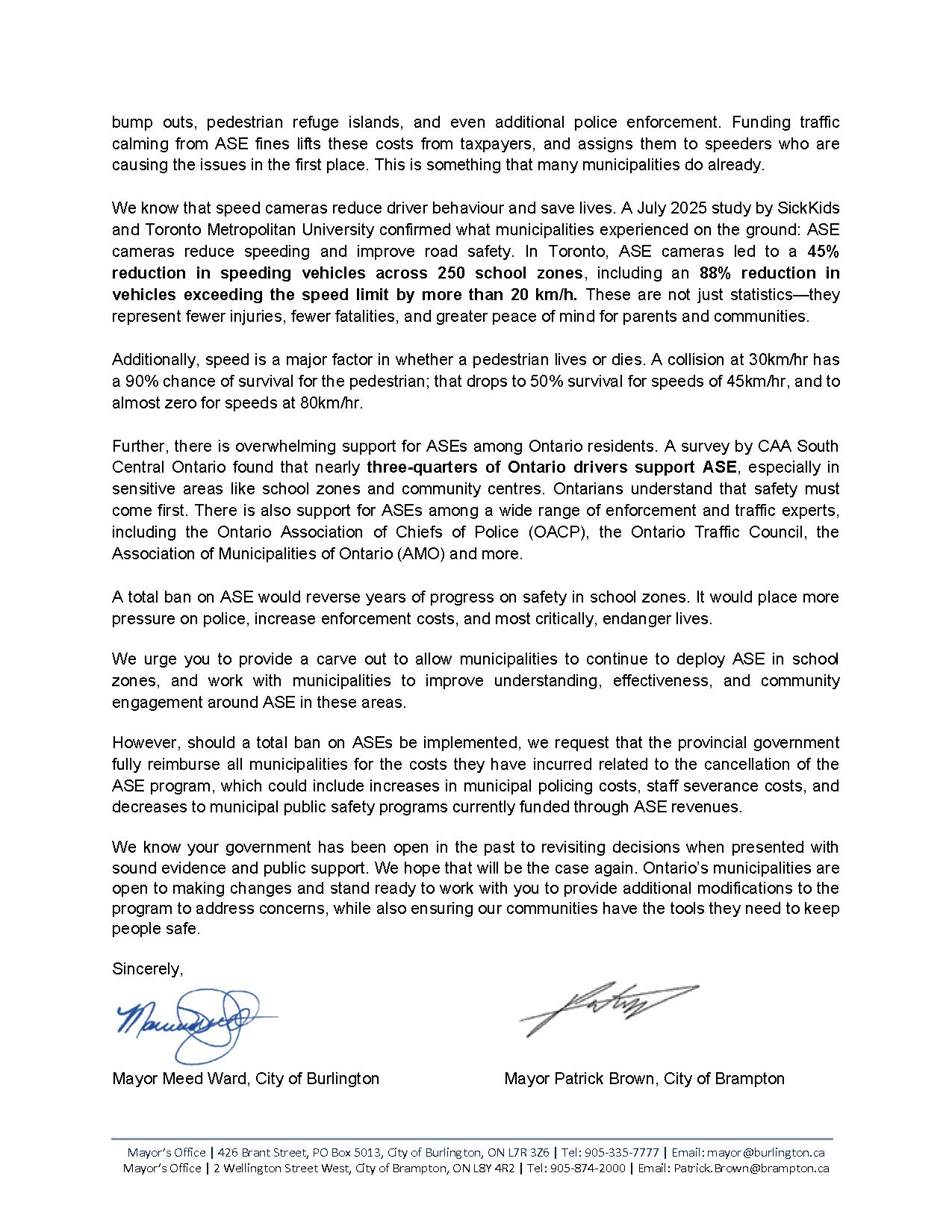
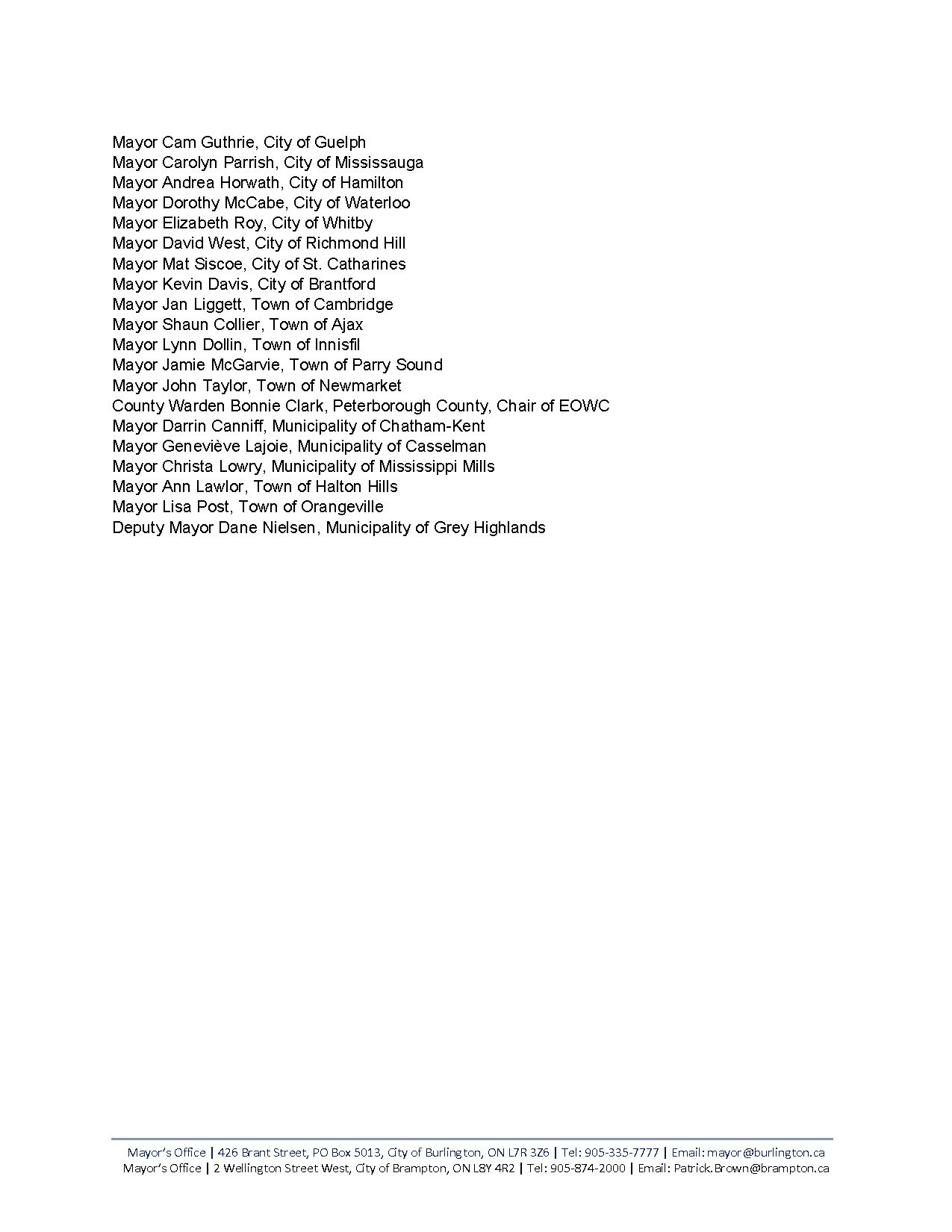
October 7, 2025 - Ontario Premier Doug Ford has made his position unmistakably clear: he rejects pleas from municipal leaders to preserve or reform automated speed enforcement (ASE) cameras. In a sharply worded response today to a letter from over 20 mayors, Ford dismissed speed cameras as a “municipal cash grab,” and reaffirmed his government’s plan to ban them outright across the province.
“The only thing municipal speed cameras are 100 per cent effective at is taking money from hard-working people,” the Premier said. “They’re cash grabs, pure and simple.”
Ford also rejected requests for financial compensation to municipalities dismantling existing systems, suggesting they should instead recoup costs from prior revenue or camera operators.
He proposed in lieu of ASE a suite of alternative “proven and proactive” traffic-calming measures such as roundabouts, speed bumps, and enhanced signage, especially in school zones.
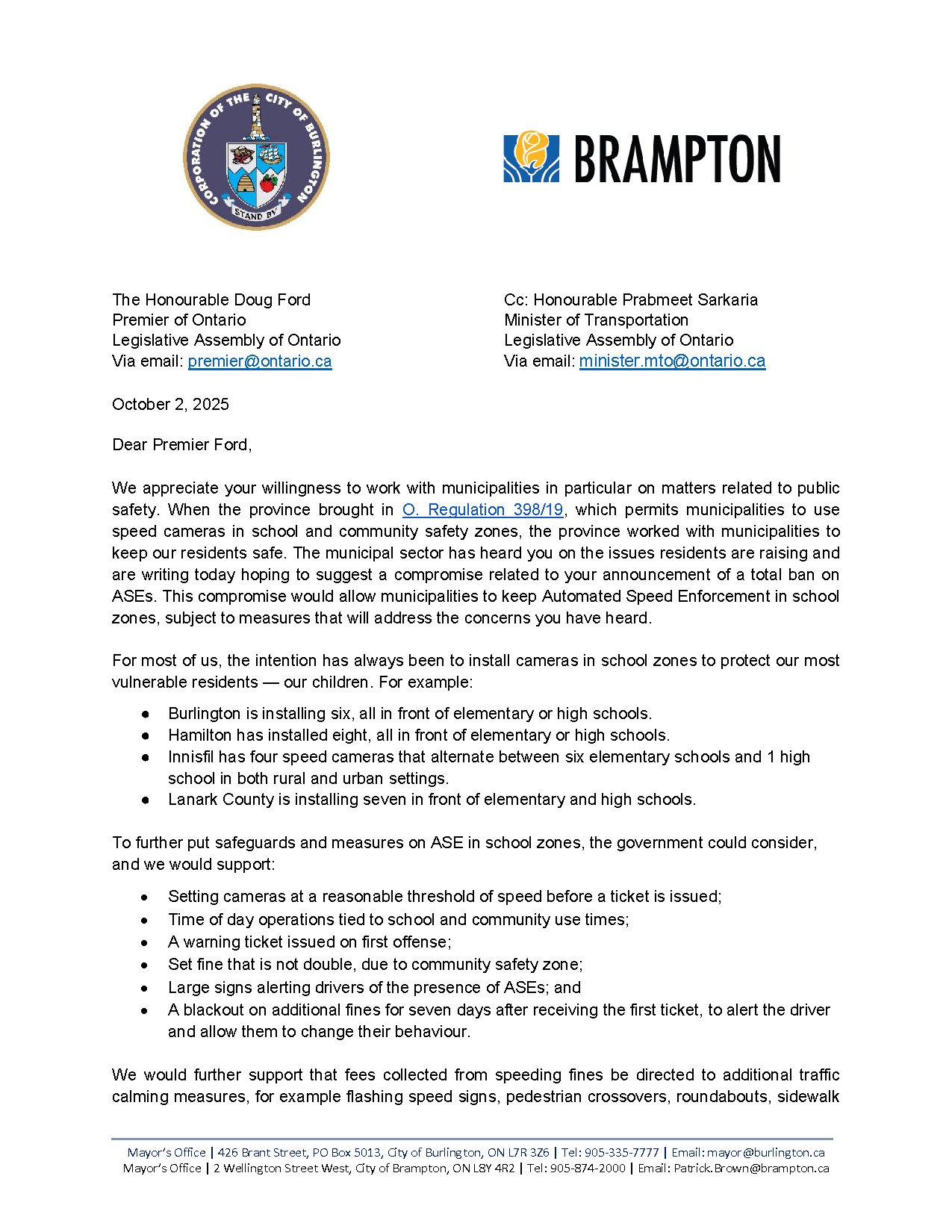
Ford’s rejection comes in response to growing municipal pressure. Many local leaders warned that a blanket ban would reverse years of progress on school-zone safety, place greater demands on police, and risk lives.
Halton Hills Mayor Ann Lawlor’s statement: aligning local concern with provincial debate
Mayor Ann Lawlor of Halton Hills recently joined more than 20 mayors in sending a letter urging the province not to scrap ASE outright.
In her statement, she frames speed cameras as a “proven method to change behaviour and reduce speed” especially in school or community safety zones. She emphasizes that these cameras are a tool of public safety, not “monitoring,” and underscores that if drivers obey speed limits, they won’t be ticketed.
Lawlor also notes that in Halton Hills, the plan was to start with a single camera (on Mountainview Road South) and rotate deployment across different zones, subject to council approval and annual budget decisions
Her statement suggests that local governments, which are closer to residents and traffic conditions, are better placed to tailor enforcement tools — a contrast with the top-down approach the Ford government is taking.
AMO’s stance: evidence, municipal autonomy, and concern over overreach
The Association of Municipalities of Ontario (AMO) issued a formal response to Ford’s announcement, expressing disappointment in the ban and warning of provincial overreach.
Key elements of AMO’s response include:
Support for ASE as a safety tool. AMO asserts that speed cameras have a proven track record in reducing speeds, particularly in school zones. They also argue ASE frees up police to focus on more serious crime.
Opposition to a blanket ban. AMO emphasizes that decisions on speed enforcement should rest with municipalities, not centrally mandated.
Financial and operational implications. AMO pledges to collect data from municipalities to quantify the fiscal impact of removing ASE systems, and to press the province to fund the cost of transition if the ban proceeds.
Implementation caveats. Under Ford’s plan, municipalities with existing ASE cameras would be required to put up larger signs (some with flashing lights) in school zones by mid-November 2025, with permanent signage by September 2026.
In sum, AMO urges a collaborative “improve, not ban” approach — modifying the program rather than eliminating it outright.
A clash of safety, revenue, and political framing
What’s at stake here goes beyond technical enforcement policy — the debate touches on municipal autonomy, how to allocate responsibility for road safety, and how to present regulation to the public.
Safety vs. revenue framing
Ford’s messaging frames ASE as primarily a tool of revenue extraction, invoking populist sentiment: “cash grab” resonates politically. He contends that if cameras truly reduced speeding, ticket counts should fall — yet ticket volumes have increased dramatically in recent years.
On the other hand, municipal leaders and AMO point to empirical evidence that ASE can reduce vehicle speeds, particularly in vulnerable zones, and that revenues are a self-financing enforcement mechanism (i.e. paid by speeders, not general taxpayers).
Municipal discretion vs provincial control
Lawlor and many mayors argue that local governments understand their neighbourhoods better — where cameras should be placed, which zones most need enforcement, and how to balance enforcement with community concerns. The province’s plan to mandate a ban is seen by some as undermining local decision-making.
AMO echoes this, warning against “provincial overreach” and calling for local capacity rather than blanket bans.
The fiscal catch
Removing ASE systems carries direct financial consequences. Municipalities may lose a source of revenue that helped offset enforcement and administrative costs. Many municipalities (or commentators) warn that property taxes or operating budgets may need to increase to compensate.
Ford’s response — that municipalities could use revenue already collected or seek recovery from camera operators — does not fully assuage those worries. Some municipalities may be left with stranded assets, contracts to cancel, and frustration over sunk costs.
Looking ahead: what happens next
Legislative ban incoming. Ford has committed to tabling legislation in the fall that would ban municipal ASE in Ontario and require removal of existing cameras.
Municipal pushback. Many mayors and AMO will be active in the public and legislative sphere pushing back, requesting carve-outs (especially in school zones), reimbursement, or alternative models.
Transition costs and safety impacts. If ASE is removed, municipalities will scramble to adopt “passive” measures (e.g. signs, speed humps), which may be less effective or slower to deploy. There’s risk that speeds will creep up, especially in zones that had previously benefited from enforcement.
Public reaction and political framing matter. Ford’s narrative about relief from “ticket fatigue” may resonate among some drivers, but urban and school-focused communities are likely to push back, framing removal as a safety rollback.
📣 CHOOSE THE RIGHT REALTOR®; CHOOSE A CORDINGLEY
Because who you choose changes everything.
BUY, SELL & #CHOOSEACORDINGLEY
— Barry & Tracy Cordingley
🌐 For more details, visit: chooseacordingley.com
#DougFord
#OntarioNews
#SpeedCameras
#TrafficSafety
#OntarioPolitics
#BreakingNews
#OntarioGovernment
#MunicipalPolitics
#AMO
#HaltonHills
#AnnLawlor
#PublicSafety
#AutomatedSpeedEnforcement
#RoadSafetyOntario
#PolicyDebate
#LocalGovernment
#ProvincialPolicy
#FordNation
#CashGrabDebate
#MayorsLetter
#OntarioMayors
#AMOResponse
#SpeedCameraBan
#FordGovernment
#OntarioDrivers

